You have decided you want to pursue a yoga teacher training. You open a browser, start searching, and within minutes you are staring at a wall of numbers. 200 hours. 300 hours. 500 hours. Some schools even advertise 50 hour or 100 hour certificates.
What do these numbers actually mean? Which one do you need? And does it even matter which one you pick?
The truth is it matters enormously. Choosing the wrong level for where you currently are wastes time, money, and in some cases sets your practice back rather than forward.
This article breaks down each certification level clearly and honestly so you can make the right decision for where you are right now.
Why Certification Hours Actually Matter
The hours in a yoga teacher training are not arbitrary numbers.
They represent a globally standardised framework developed by Yoga Alliance, the international body that sets the benchmark for yoga education worldwide.
When a training is described as 200, 300, or 500 hours, those hours correspond to specific required contact hours across defined subject areas including asana, pranayama, anatomy, philosophy, teaching methodology, and practicum.
Here is what most people miss. The hours do not just determine how long you spend in training. They determine the depth of knowledge you walk away with, the teaching credential you earn, and the level of professional recognition you receive in the global yoga community.
A 200 hour graduate and a 500 hour graduate both have yoga certifications. But the depth of their understanding, the breadth of their teaching capability, and the professional opportunities available to them are significantly different.
Understanding this framework before you enrol is the single most important piece of research you can do.
200 Hour: The Foundation Every Yogi Needs
The 200 hour yoga teacher training is the entry point. It is the globally recognised foundation certification and the starting point for virtually every serious yoga practitioner regardless of their long term goals.
What It Covers
A quality 200 hour programme covers the full spectrum of foundational yoga education including:
- Core asana practice across primary poses and their modifications
- Pranayama fundamentals including Nadi Shodhana, Kapalabhati, and Bhramari
- Yoga philosophy including the Yoga Sutras of Patanjali and the Eight Limbs
- Basic anatomy and physiology as it applies to yoga practice and teaching
- Teaching methodology including how to sequence, cue, and hold a safe class
- Introduction to Ayurveda and the relationship between lifestyle and practice
- Practicum hours spent actually teaching under supervision
Who It Is For
The 200 hour is designed for beginners to intermediate practitioners. You do not need years of studio practice behind you to enrol. Many participants come with six months to two years of regular practice. Some come with less.
What you need is not advanced flexibility or prior teaching experience. You need genuine curiosity, physical readiness for intensive daily practice, and the commitment to show up fully for the duration of the programme.
Here is the thing most people do not realise about the 200 hour. A significant proportion of participants have no intention of ever teaching professionally.
For anyone at the beginning of their serious yoga journey, a 200 hour yoga teacher training in Rishikesh provides internationally recognised Yoga Alliance certification, a deeply grounded foundation in classical yoga, and a transformation that goes well beyond the mat.
Duration and Format
Most 200 hour programmes run between 23 and 28 days as a residential immersion. Some schools offer split format programmes spread over several months for students who cannot commit to a full month away.
300 Hour: Going Deeper After the Basics

The 300 hour yoga teacher training is not a standalone programme. It is an advanced continuation designed specifically for graduates of a 200 hour certification.
What It Covers
Where the 200 hour builds the foundation, the 300 hour deepens and expands it considerably. Typical areas of advanced study include:
- Advanced asana including deeper backbends, inversions, and arm balances
- Advanced pranayama and breathwork including Kumbhaka and Bandhas
- In-depth yoga philosophy covering the Bhagavad Gita, Samkhya philosophy, and Tantra
- Advanced anatomy focusing on biomechanics, injury prevention, and therapeutic applications
- Sequencing theory at an advanced level including theme-based and lineage-specific sequences
- Yoga Nidra, advanced meditation, and subtle body anatomy including chakras and nadis
- Business of yoga including building a sustainable teaching practice
Who It Is For
The 300 hour is for practitioners who have completed their 200 hour training and have been teaching or practicing seriously for at least one to two years afterward. It is the intermediate to advanced level of the certification pathway.
Want to know the best part? Completing a 300 hour programme combined with your existing 200 hour certification earns you the Yoga Alliance RYT 500 designation, which is the most widely recognised advanced teaching credential in the global yoga industry. You get the 500 hour credential through two separate immersions rather than one continuous programme.
Duration and Format
300 hour programmes typically run between 28 and 35 days as a residential immersion. The additional days reflect the significantly deeper content covered compared to the 200 hour foundation.
500 Hour: The Advanced Path
The 500 hour yoga teacher training represents the highest level of initial yoga education recognised by Yoga Alliance. It is the advanced path and the most comprehensive single programme available in the standard certification framework.
Two Ways to Reach 500 Hours
There are two distinct routes to a 500 hour certification:
Route 1: Combined pathway. Complete a 200 hour programme first, practice and teach for one to two years, then complete a separate 300 hour advanced programme. The combined hours earn the RYT 500 designation through Yoga Alliance.
Route 2: Direct 500 hour programme. Some schools offer a single continuous 500 hour immersion combining foundational and advanced content in one extended programme. These typically run 50 to 60 days and are designed for dedicated practitioners who want to complete the full certification journey in one go.
H3: What It Covers
The 500 hour covers everything in the 200 and 300 hour programmes and extends further into specialised areas including therapeutic yoga, advanced teaching practicum, yoga for specific populations such as seniors, prenatal, and children, and in many cases specialist modules in Ayurveda, sound healing, or specific lineage studies.
Who It Is For
The 500 hour is for serious practitioners and committed teachers. It is not a beginner programme under any framing. The depth of content, the physical demands of an extended daily practice schedule, and the philosophical complexity of the material require a solid foundation that only genuine experience can provide.
Research reveals that graduates of 500 hour programmes consistently report the highest levels of teaching confidence, professional opportunity, and personal transformation of any certification level. The investment in time, effort, and resources is significant. So is the return.
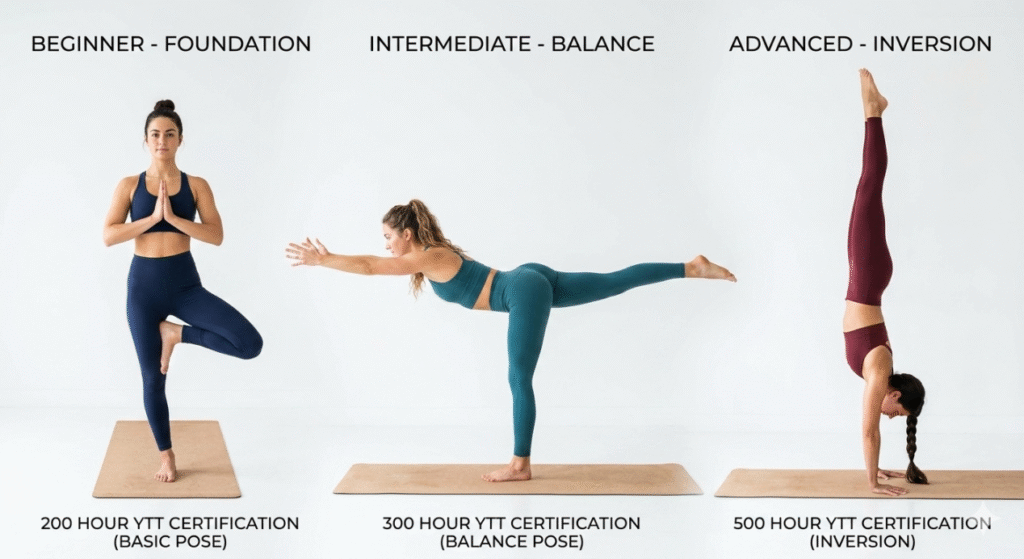
Beginner, Intermediate and Advanced: A Simple Breakdown
If the hours are still confusing, this table makes the decision straightforward.
| Certification | Level | Prior Experience Needed | Yoga Alliance Credential | Best For |
|---|---|---|---|---|
| 200 Hour | Beginner to Intermediate | 6 months to 2 years of practice | RYT 200 | First time trainees, foundation seekers |
| 300 Hour | Intermediate to Advanced | 200 hour cert plus 1 to 2 years teaching | RYT 500 (combined) | Deepening knowledge and teaching skills |
| 500 Hour | Advanced | Strong foundation, serious commitment | RYT 500 | Dedicated practitioners and professional teachers |
The bottom line is simple. If you are asking which one to start with, the answer is almost always the 200 hour. It is not a lesser option. It is the correct starting point for the vast majority of people at the beginning of their serious yoga education journey.
How to Choose Based on Where You Are Right Now
Now here’s where it gets practical. Forget the numbers for a moment and answer these three questions honestly.
How long have you been practicing consistently? Less than two years of regular practice means the 200 hour is your answer. Full stop.
Have you already completed a 200 hour certification? If yes and you have been teaching or practicing seriously for at least a year since completing it, the 300 hour is your natural next step.
Are you committed to yoga as a long term professional path? If the answer is yes and you have the time and resources to commit to an extended immersion, the direct 500 hour route offers the most comprehensive single transformation available in yoga education.
Location matters too. Rishikesh remains the global gold standard for yoga teacher training education. The combination of experienced teaching lineages, Himalayan environment, and the living tradition of yoga practice that permeates the city creates a learning environment that simply does not exist anywhere else on earth.
A structured yoga teacher training course in Rishikesh whether at the 200, 300, or 500 hour level provides not just internationally recognised certification but the kind of deep immersive experience that shapes how you practice and live long after the programme ends.